Commercial Mirrors in Redmond, Oregon: Types, Uses, and How to Choose the Right One
If you manage a business in Redmond, Oregon, mirrors are not “just décor.” They’re a functional building material that impacts lighting, cleanliness, customer experience, staff workflow, safety, and even how big a space feels. From gyms and studios to salons, retail, restaurants, clinics, offices, and multifamily common areas, commercial mirrors pull a lot of weight for a relatively thin piece of glass.
This guide breaks down the most common commercial mirror types, what they’re used for, how to pick the right spec, and what to expect during a professional install in Redmond.
If you want quick help picking the right mirror for your space, Glass Daddy Redmond can walk your site, measure, and recommend the best mirror type for durability, safety, and the look you’re going for.
Why Commercial Mirrors Are in High Demand in Redmond
Redmond is growing. More tenants, more build-outs, more remodels, more gyms, more boutique businesses, more medical and professional offices. And every one of those spaces tends to need mirrors for one of these reasons:
- Visibility and usability (fitness, dance, barbershops, salons, locker rooms)
- Space and light (retail, restaurants, lobbies, offices)
- Safety and supervision (hallways, corners, back-of-house)
- Brand presentation (high-end finish in customer-facing areas)
- Tenant expectations (modernized commercial interiors, updated restrooms)
Commercial mirrors take more abuse than residential mirrors, so the “cheap big-box mirror” approach usually turns into chips, edge damage, moisture issues, and replacement headaches.
The Main Types of Commercial Mirrors
1) Standard Float Glass Mirrors
This is the most common commercial mirror: smooth, clear, and clean-looking.
It’s used in:
- Restrooms
- Hallways and lobbies
- Offices and conference rooms
- Retail walls and fitting areas
Best for: General-purpose commercial spaces where the mirror is not likely to be impacted.
Things to know: You can choose different thicknesses (more on that below). Thicker mirrors tend to look flatter and feel more “premium” in larger formats.
2) Safety-Backed Mirrors
Safety-backed mirrors are designed to hold together if the glass breaks. The back has a safety film that helps prevent shards from scattering.
You’ll see these specified in:
- Gyms and fitness studios
- Dance studios
- Childcare centers
- Public spaces with high traffic
- Areas where impacts are possible
Best for: Spaces where safety is a priority and people may be close to the mirror (or moving fast near it).
Why businesses choose it: If a mirror ever breaks, safety backing helps reduce the risk of injury and reduces cleanup hazards.
3) Tempered Mirrors
Tempered glass is heat-treated for strength. If it breaks, it breaks into small pebble-like pieces rather than large sharp shards.
Common in:
- High-traffic areas
- Commercial restrooms (especially in some jurisdictions)
- Athletic facilities
- Spaces where codes or risk management demand extra safety
Best for: Businesses that want the highest impact resistance and a safer break pattern.
Important note: Not every mirror is tempered by default. Tempering affects lead times and cost, and it should be planned early in a remodel.
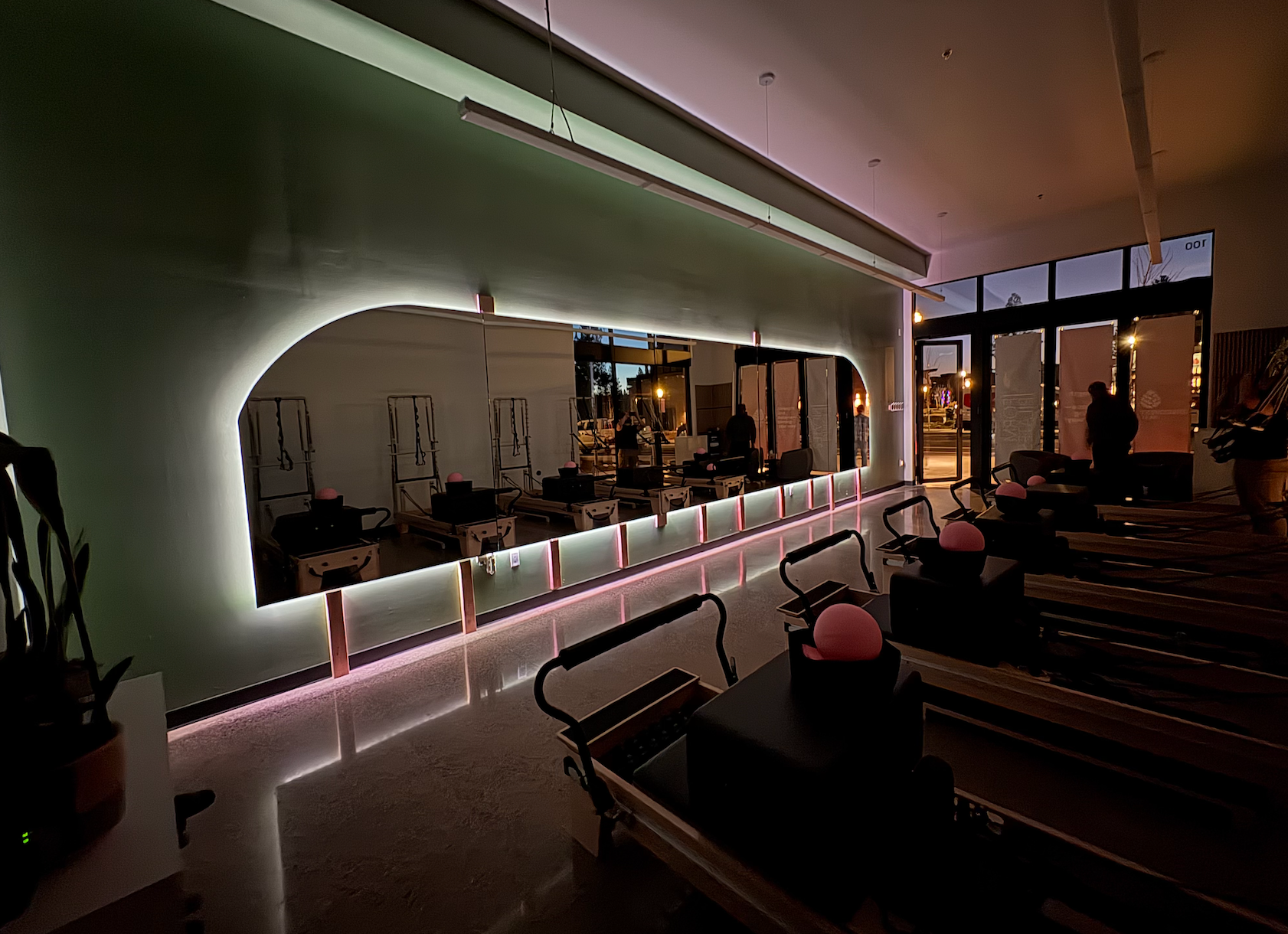
4) Gym and Studio Mirrors
These are typically large-format mirrors installed in panels across a wall, often with safety backing and careful seam alignment.
Used in:
- Gyms
- Yoga studios
- Dance studios
- Martial arts studios
- Physical therapy clinics
Best for: Spaces where clients need a full-body view, accurate reflection, and a polished look.
Install matters: The wall needs to be prepped correctly to avoid waviness, “funhouse” distortion, or visible seams.
5) Vanity and Restroom Mirrors
Commercial restroom mirrors can be:
- Single large mirrors over long counters
- Separate mirrors above individual sinks
- Mirrors installed with lighting and accessories
Often paired with:
- LED lighting
- Metal channels or clips
- J-box cutouts and outlet cutouts
- Custom shapes for design-forward restrooms
Best for: Restaurants, offices, retail, medical spaces, and multifamily common areas where presentation matters.
6) Framed Commercial Mirrors
A framed mirror instantly elevates a commercial space and adds protection to the mirror edges.
Common frame materials:
- Aluminum
- Stainless steel
- Wood (more common in hospitality and retail)
- Powder-coated metal
Best for: Customer-facing areas where you want a high-end look and better edge durability.
Pro tip: Frames also help hide minor wall imperfections and can reduce the “construction-grade” feel.
7) Polished Edge Mirrors
Polished edges give a clean finished look when the mirror is installed without a frame.
Common in:
- Modern offices
- Clean retail designs
- Bathrooms with minimal design
Best for: Spaces where the mirror edge will be visible.
Edge options: Flat polish, pencil polish, beveled edges, and more.
8) Beveled Edge Mirrors
Beveling adds an angled edge that catches light and creates a more decorative finish.
Used in:
- Hospitality
- Upscale retail
- Lobbies
- High-end restroom designs
Best for: Businesses that want a more finished, premium aesthetic.
9) Antique Mirrors and Specialty Finishes
Antique mirrors have a deliberately aged look. They can make a space feel elevated and custom without being loud.
Used in:
- Bars and restaurants
- Boutiques
- Salons
- Hospitality feature walls
Best for: Statement design areas where the mirror is part of the brand experience.
Reality check: Specialty mirrors cost more and may require longer lead times, but they can turn a plain wall into a “signature” feature.
10) Tinted Mirrors
Tinted mirrors (like bronze or gray tones) add warmth or mood.
Used in:
- Hospitality
- High-end restrooms
- Modern retail
- Feature walls
Best for: Spaces where you want design control and a more curated feel than standard silver.
11) One-Way / Two-Way Mirror Glass
Used for observation or privacy-controlled areas, typically in:
- Security and loss prevention
- Specialized offices
- Certain medical or training environments
Best for: Specific commercial needs where privacy and visibility are controlled by lighting conditions.
Important note: This is not a “regular mirror.” It needs correct lighting design and the right glass selection to work as intended.
12) Convex Safety Mirrors
These are the curved “corner mirrors” used for safety and supervision.
Common in:
- Warehouses
- Back hallways
- Parking garages
- Loading areas
- Blind corners
Best for: Reducing collisions, improving visibility, and enhancing workplace safety.
Mirror Thickness Options and Why They Matter
Commercial mirrors are commonly available in different thicknesses. Thicker mirrors:
- Feel more solid
- They are less prone to waviness
- Look flatter and cleaner in larger sizes
- Can be more durable during installation and service life
A pro will recommend thickness based on mirror size, wall condition, and how the mirror will be mounted.
Mounting Methods in Commercial Spaces
The mirror type is only half the job. How it’s installed affects safety, longevity, and how “high-end” it looks.
Common commercial mounting methods include:
- Mirror mastic (adhesive): Clean look, but the wall must be properly prepped and the adhesive must be mirror-safe.
- J-channel or metal channel: Supports the mirror and gives a crisp finished edge.
- Clips: Common in restrooms and utility installs; quick and serviceable.
- Standoff mounts: Decorative mounts that hold the mirror off the wall for a modern look.
- Full framed systems: Added protection and design consistency.
If your space has moisture (like restrooms, locker rooms, spas), correct materials and sealing matter even more.
Common Commercial Mirror Use Cases in Redmond
If you’re wondering what type you likely need, here are typical matches:
- Gym/studio: Safety-backed large panels, sometimes tempered, often installed with channels for support.
- Salon/barbershop: Polished edge or framed mirrors, often custom-sized per station with lighting integration.
- Restaurant/bar: Tinted or antique mirrors for ambiance, or large mirrors to open up tight dining rooms.
- Office/lobby: Large clean mirrors to increase light and make the space feel bigger.
- Retail: Fitting room mirrors, wall mirrors, feature mirrors for merchandising.
- Medical/dental clinics: Clean, easy-to-maintain mirrors with safe mounting and a professional finish.
- Warehouse/industrial: Convex safety mirrors at corners and intersections.
What to Look for When Hiring a Commercial Mirror Installer
Commercial mirror work isn’t the place for “good enough.” It needs to look straight, stay bonded, and hold up to cleaning and traffic.
A solid commercial mirror installer should:
- Measure precisely and verify wall conditions
- Recommend appropriate mirror type (standard, safety-backed, tempered)
- Use mirror-safe adhesives and proper support methods
- Manage seams and alignment for a clean visual line
- Handle cutouts (outlets, lighting, switches) cleanly
- Install with safety and long-term durability in mind